 Orange Beach Golf Cart Repair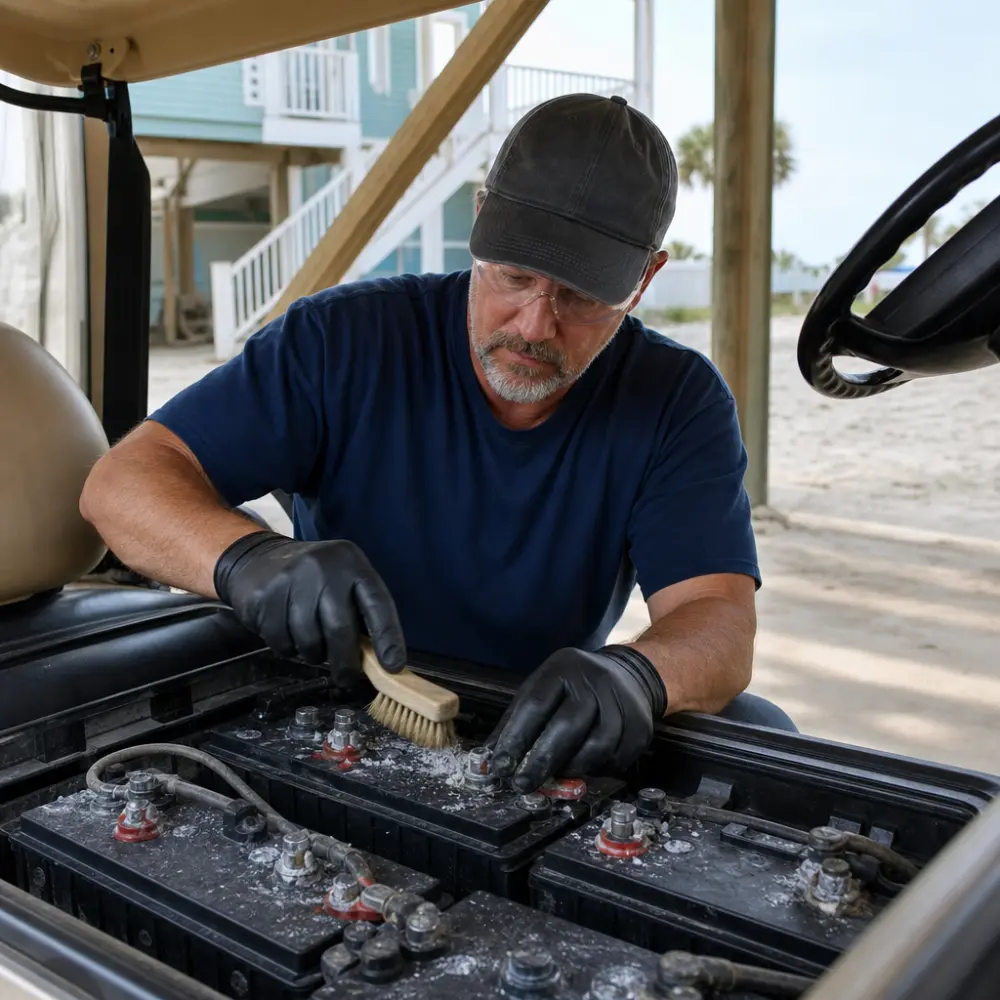
Orange Beach Golf Cart Repair sends a technician to your condo lot, driveway, or cart barn anywhere on the Alabama Gulf Coast and fixes your cart on-site: batteries, brakes, tires, chargers, solenoids, motors, controllers, and lights. A full lead-acid battery pack runs $1,200 to $1,800 installed, brake work $75 to $400, tires $75 to $150 each, and the $50 to $100 service call is applied toward your repair. Describe the symptom by form and we usually arrive with the likely parts already on the truck.
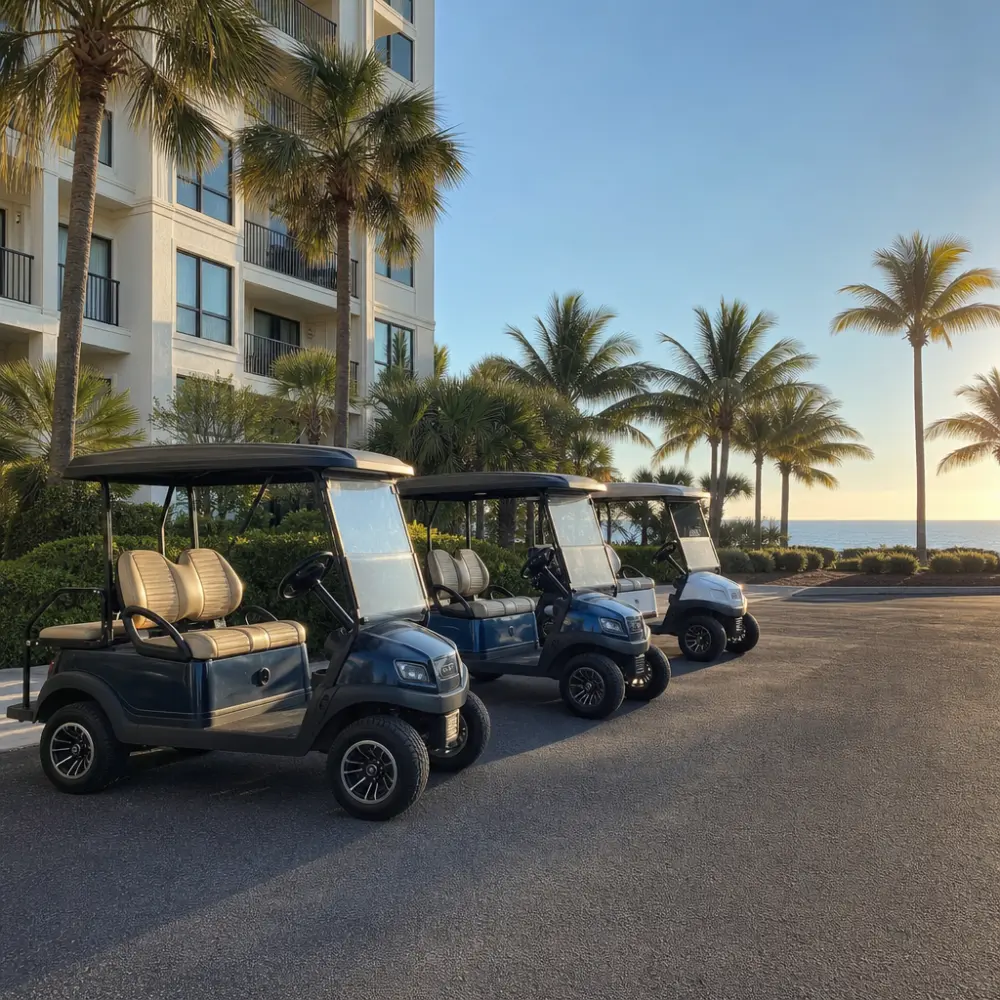
Orange Beach is a resort town before it is anything else. The 2020 Census counted 8,095 year-round residents on a barrier island that swells many times over every summer with weekly vacation renters, and the city was only incorporated in 1984. Golf carts here are not a retirement-community amenity the way they are further inland; they are how a family gets from a rented condo to the beach, how a homeowner runs to the Winn-Dixie without moving the truck, and how a rental property owner keeps guests happy enough to book again. A dead cart in July, at the peak of the season, is a different kind of emergency than a dead cart in a quiet retirement village, and that is the service this was built for.
What we fix, where you are
- Mobile golf cart repair: the core service. On-site diagnosis and repair of whatever is wrong: will not move, will not charge, weak on the way back from the beach, clicking, cutting out. All major brands, electric and gas.
- Battery replacement: new lead-acid packs installed with haul-away of the old cores, plus honest lead-acid versus lithium math for a cart that gets ridden hard every day of a Gulf Coast summer.
- Brakes and tires: adjustments, shoes, drums, and new tires installed wherever the cart is parked. Sand tracked in from the beach and salt on the pads both wear faster than owners expect.
- Motor and controller repair: solenoids, speed controllers, and drive motors diagnosed with meters before anything gets replaced.
- Charger repair: carts that “will not take a charge” are often a charger, charge port, or salt-corroded connection, not a battery problem. We test before we sell you anything.
- Tune-up service: the Gulf Coast annual: battery water and load test, terminal cleaning, brakes, tires, lights, and a corrosion check that matters on every single cart out here, not just the ones on a canal.
- Lights and street-legal equipment: headlights, brake lights, signals, mirrors, and reflectors installed to what Baldwin County’s golf cart rules actually require.
Full ranges for everything are published on the pricing page. Competitors make you call for a number. We would rather you see it first.
Why carts break the way they do out here
Salt is the whole story, not a coastal exception. Orange Beach sits on Perdido Key, a barrier island between the Gulf of Mexico and a network of bays and canals, and Gulf Shores and the rest of this service area are within a few miles of saltwater in every direction. That means the corrosion problem that only shows up in one neighborhood on most golf cart sites (a canal community, a beach town) is the default condition here. Battery posts, cable lugs, charge-port pins, and solenoid terminals all pick up salt-laden air and start oxidizing faster than they would fifty miles inland. Corroded connections add resistance, resistance mimics a dying battery pack, and plenty of owners end up shopping for a $1,200 pack when the fix is a cable-and-terminal service well under $150. A voltage-drop check along the main cables is part of every diagnostic we run.
Heat still does its damage. NOAA’s 1991 to 2020 normals for Mobile Downtown Airport, the regional station we found published data for, put the July average high near 91.7°F and August near 91.9°F, with summer humidity that keeps things from cooling off much overnight. Inside a flooded lead-acid battery, that heat evaporates electrolyte faster than the catalog assumes, and once the plates are exposed they sulfate and lose capacity permanently. It is the same mechanism that shortens pack life anywhere in the Deep South, just paired here with the salt.
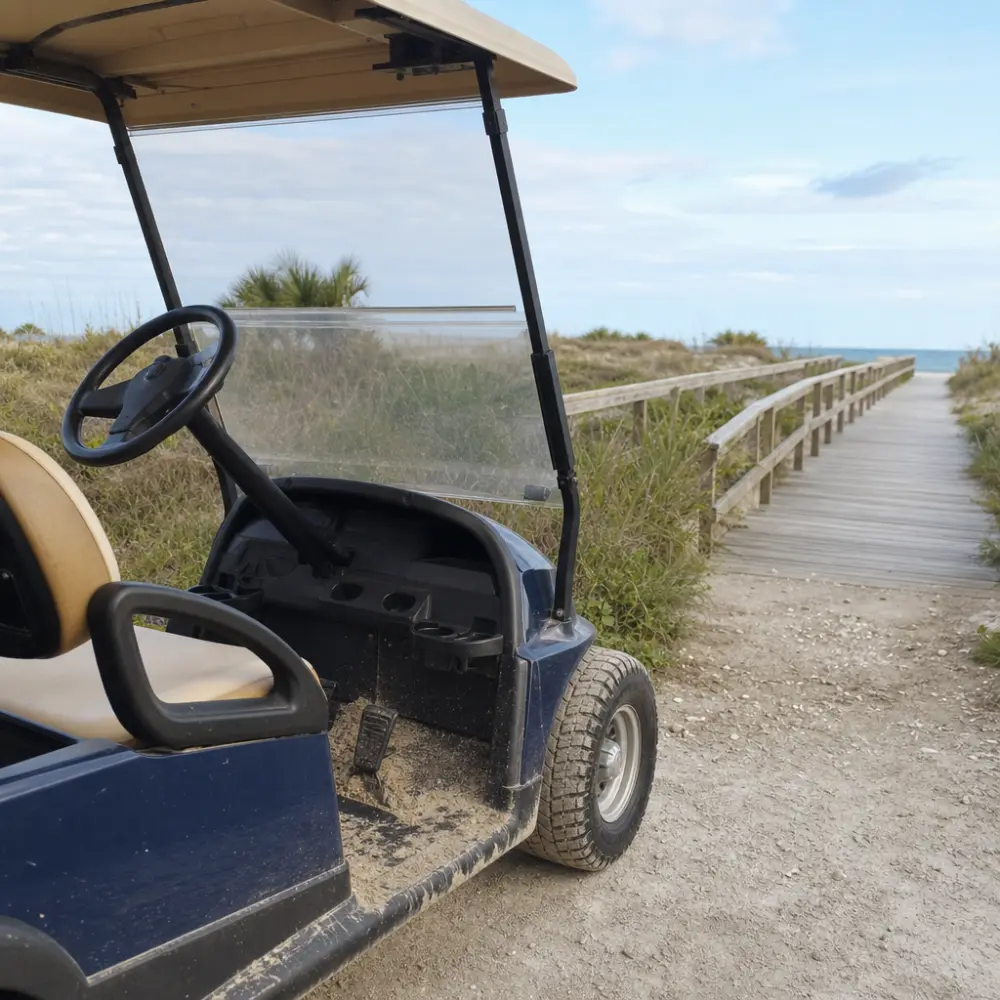
The ground is sand, and the beach comes home in the wheel wells. This is a barrier island; the native soil under Orange Beach and most of this service area is beach sand, not the clay you get further inland in Alabama. Sand gets tracked into brake drums and packed around bearings by every trip to and from the water, which is most trips.
Hurricane season changes the job. Hurricane Ivan made landfall at Gulf Shores in September 2004 as a Category 3 storm with a 10 to 15 foot storm surge along coastal Baldwin County, and Orange Beach alone saw damage to roughly 60 percent of its wooden structures. Hurricane Sally came ashore near Gulf Shores in September 2020 and dropped a state-record 29.99 inches of rain on Orange Beach in under two days. Ahead of forecast storms we prioritize charger and battery calls so evacuating owners leave with a full charge, and after landfall we see the other side: carts that sat in storm surge, packs that were left connected through a power outage, and controllers that took a surge when the power came back. A cart that has taken on water should not be charged or driven until it has been checked.
Golf cart or LSV: the Baldwin County rule
Alabama does not run golf carts under a single statewide statute the way some states do. Along this stretch of coast the controlling law is a constitutional amendment specific to Baldwin County, Ala. Const. Baldwin County §15.70 (Amendment 921), which lets a municipality here designate streets for golf cart use once it determines carts can travel them safely, subject to a hard cap: no street with a posted speed limit over 25 mph may be designated. The amendment also sets the baseline equipment (headlights, brake lights, turn signals, a windshield), requires a driver’s license and liability insurance, and lets a city write stricter rules on top.
Orange Beach used that authority in Chapter 70, Article VIII of its city code, most recently rewritten by Ordinance No. 2024-1487. The city inspects and permits every cart for a $100 fee good for four calendar years, requires headlights mounted no higher than 36 inches, brake lights, turn signals, a windshield, a rearview mirror, working brakes and steering, and proof of liability insurance at the same limits Alabama requires for a car. The ordinance’s own findings section spells out why the list of designated streets stops where it does: the island has three arterial roads, State Highway 180 (Canal Road), State Highway 182 (Perdido Beach Boulevard), and State Highway 161 (Orange Beach Boulevard), and all three are multi-lane state highways posted well above 40 mph. None of them, and no street feeding directly onto them at a dangerous point, made the list. Everything else, well over 170 residential streets by our own count of the ordinance’s own table, is fair game once posted.
Gulf Shores, next door, took a narrower approach. Its ordinance designates cart streets only inside specific subdivisions, Gulf Wood Highlands, Cypress Park, Craft Farms, Martyn Woods at Bon Secour, Aventura, and the West Lagoon Avenue area, rather than a citywide list, and it sets an 18-year-old minimum age, a 10 p.m. cutoff, and an orange safety flag at least six feet high that Orange Beach does not require. If your cart crosses the city line, the rules change with it. The full comparison, section by section, is on our street-legal rules page.
Where the carts live
Orange Beach itself runs from the older canal neighborhoods near Terry Cove and Cotton Bayou out to Ono Island, a private, guard-gated barrier island community of more than 1,100 homes reached by its own bridge off Perdido Beach Boulevard, and along to Perdido Key at the Florida line. Gulf Shores picks up west of the city line and runs to the Fort Morgan Road split, with its own golf communities like Craft Farms and Gulf State Park’s campground anchoring the middle of town. Foley is the inland hub up State Highway 59. Fort Morgan is the beach-house peninsula out past Gulf Shores, ending at the historic fort itself. Perdido Key is technically Florida, a short bridge ride east across Perdido Pass. Lillian and Bon Secour sit on the bay sides, and Magnolia Springs is the historic river town inland of Foley.
How a mobile visit works
- Tell us the symptom. Will not move, clicks but no go, will not charge, sags on the way back from the beach, squeals when braking. Most problems narrow down fast from a good description, so the tech arrives with the likely parts.
- We come to you. Condo lot, driveway, or cart barn, at a scheduled window. The $50 to $100 trip fee includes the diagnostic and gets applied to the repair.
- We diagnose before we recommend. Load test on each battery, voltage checks across the pack, charger output test, voltage drop along the main cables, solenoid and controller checks. Salt corrosion gets ruled in or out before anything gets sold.
- Flat quote on the spot, fix on the spot. Battery sets, solenoids, brake shoes, and tires are usually on the truck. Approve the number and most jobs are done in that same visit.
- Finish clean. Lead-acid packs get watered and terminals cleaned and coated, everything gets a torque check and a test drive, and old batteries leave with us for recycling.
Straight answers, published prices
Two things we will not do. We will not pretend to be something we are not: we are an independent service, not an authorized dealer or warranty center for Club Car, E-Z-GO, Yamaha, ICON, or Evolution. If your cart is under factory warranty, your selling dealer should handle warranty work. And we will not sell parts you do not need. A cart that will not charge gets a charger and charge-port test before anyone talks about a battery pack, and a weak cart gets a per-battery load test before we condemn six batteries when salt on one cable end is the problem. If a repair does not make sense against the value of an old rental-fleet cart, we will say that too.
The work is done by experienced, insured local golf cart technicians. More on how we operate is on the about page, what actually breaks first on each brand is on our Club Car, E-Z-GO, and Yamaha problems page, and the FAQ answers the questions we hear most.
Get a fast quote
A lot of owners land here after typing “golf cart repair near me” from a condo balcony with a cart that will not leave the parking lot. That is exactly the call this service was built for. Tell us the brand, model year if you know it, whether it is a 36V or 48V electric or a gas cart, and what it is doing. A photo of the battery compartment or dash helps. We will come back fast with a flat number and a scheduling window, and in most cases we can reach you same-day or next-day anywhere from Ono Island to Fort Morgan to the Foley city line.